
Do You Need a DJ for a Small Wedding? 6 Honest Questions to Ask First
Table of Contents
You've trimmed the guest list. Maybe 30 people. Maybe 50. The venue is locked in, the food is sorted, and now you're staring at the entertainment line in your spreadsheet wondering if you really need to spend money on a DJ for a wedding this small.
Here's our honest take after years of running small weddings across Southeastern Wisconsin: yes, most small weddings still benefit from a professional DJ, but for completely different reasons than larger weddings. At 30 guests, a DJ isn't there to fill a dance floor. They're there to handle ceremony audio, toast microphones, timeline cues, and reading a small room in real time.
If you're weighing your options for a wedding dj in Milwaukee, the six questions below will help you decide based on your actual setup, not generic advice. We've ordered them by what trips couples up most often.
Quick Answer for the Scrollers
A small wedding (51 to 100 guests) and an intimate wedding (under 50, sometimes called a micro wedding) usually still need a DJ because ceremony sound, toast amplification, and timeline coordination don't shrink just because the guest count does.
Many couples skip the DJ thinking a Spotify playlist will do the job, then realize at the rehearsal that nobody has a microphone for the officiant.
Micro weddings now make up roughly 6 percent of US weddings, but nearly half of all engaged couples consider one before booking, according to The Knot 2026 Real Weddings Study.
Question 1: Will Every Guest Actually Hear Your Ceremony?
This is the question most couples forget to ask, and the one that quietly ruins more small wedding ceremonies than anything else.
The general rule: if your ceremony is indoors, has under 50 guests, no background noise, and a strong-voiced officiant, you can sometimes get away without amplification. Anything outdoor, any breeze, any soft-spoken speaker, any background traffic, and your back rows will struggle.
DJ Ben Boylan, who has run more than 50 weddings in a single year, puts it plainly:
"If you have more than 20 guests, then you need a microphone at your wedding ceremony. The ones seated behind the first or second row won't be able to hear well."
A typical small ceremony still needs:
- A lavalier or headset mic for the officiant
- A handheld mic for readers and vows
- At least one powered speaker placed past the second row
The Wisconsin reality: Lake Country backyards, county park pavilions, and vineyard properties around Milwaukee are mostly open-sided spaces. Natural projection fails fast in open air. We always suggest a venue walkthrough before deciding whether to skip amplification.
Question 2: Who Runs the Mic During Toasts in a Mixed Indoor and Outdoor Venue?
Small Wisconsin weddings often shift spaces. Ceremony outside under the trees, cocktail hour on the patio, dinner inside the barn or tent. Each transition is a microphone handoff that nobody plans for.
Without a DJ, here's what usually happens. The officiant takes their lapel mic off after the ceremony. The maid of honor stands up at dinner, raises her voice, and the people at the back of the room miss half the speech. The toast becomes a strained shout over clinking glasses.
A pro moves the wireless handheld between the officiant, the readers, the toast-givers during cocktail hour, and the MC duties at dinner. It's not a glamorous job, but it's the difference between guests hearing your maid of honor's speech and watching her mouth move.
Sound coverage across multiple spaces also takes more gear than couples expect. As Wonderwall Events noted in late 2025, outdoor venues may require additional sound equipment to reach guests in distant areas, and direct sunlight can damage powered speakers and lighting if they aren't set up properly.
Question 3: Who Reads the Room When You Have 30 Guests Instead of 130?
Reading the room at a 130-guest wedding is forgiving. If three slow songs in a row empty the dance floor, you have a buffer. Half the room is still seated anyway.
At 30 guests, that buffer doesn't exist. Every empty chair is visible. The energy shift you'd feel at a large wedding over 30 minutes happens at a small wedding in five.
The Knot Worldwide's 2026 Real Weddings Study notes that personality is a top deciding factor for guest-facing professionals like DJs. That matters more at small weddings because the feedback loop is shorter. A small wedding DJ is adjusting tempo every 2 to 3 songs, not every 5 or 6.
forCelebrations summed up the Spotify-versus-DJ question well in early 2026: a streaming playlist doesn't notice when the dance floor empties or energy drops, while a professional DJ adjusts constantly and often invisibly, responding to body language, reactions, timing, and mood.
Real couples back this up. One bride who hosted a 46-guest intimate wedding wrote on WeddingWire that her DJ and MC kept guests entertained and on their feet all evening, playing music based on what they saw was getting the crowd moving. Another couple who downsized from 150 to 32 guests during the pandemic said the wedding wasn't awkward at all because the DJ kept everyone on the spacious dance floor.
Question 4: What Happens When Your Playlist Runs Out an Hour Early?
This is the question nobody writes about, but it's the most common failure mode for DIY small weddings.
Let's do the actual math. According to playlist guidance from professional wedding bands and event teams in 2025, you need roughly 15 songs per hour of dance floor music, with songs averaging 3 to 4 minutes each.
A 25-person wedding still has:
- Cocktail hour (about 1 hour, roughly 15 songs)
- Dinner (about 1.5 hours, 10 to 15 songs)
- Optional dancing (1 to 2 hours, 20 to 30 songs)
That's 45 to 60 carefully curated songs minimum. Not a vibe playlist. Not a "songs we like" mix.
Then there's the hidden failure mode: Spotify shuffles. Your playlist ends, and the algorithm auto-plays a related artist. Suddenly there's a song about a breakup playing during dessert. Or your playlist hits a track you forgot was on there with lyrics that don't land right.
A DJ pre-screens for this. A phone does not.
The direct answer worth pinning: A small wedding still typically needs 45 to 60 songs total to cover cocktail hour, dinner, and dancing without repeats, working out to roughly 15 songs per hour of active dance floor time.
One real couple admitted on AskMetaFilter after the fact: "Then the playlist ran out and we started repeating. Oops."
Question 5: How Does a DJ Actually Change the Playbook for a Small Group?
Competing posts say "DJs adjust." They rarely say what changes mechanically. Here's what actually shifts at a small wedding.
Equipment Sizes Down
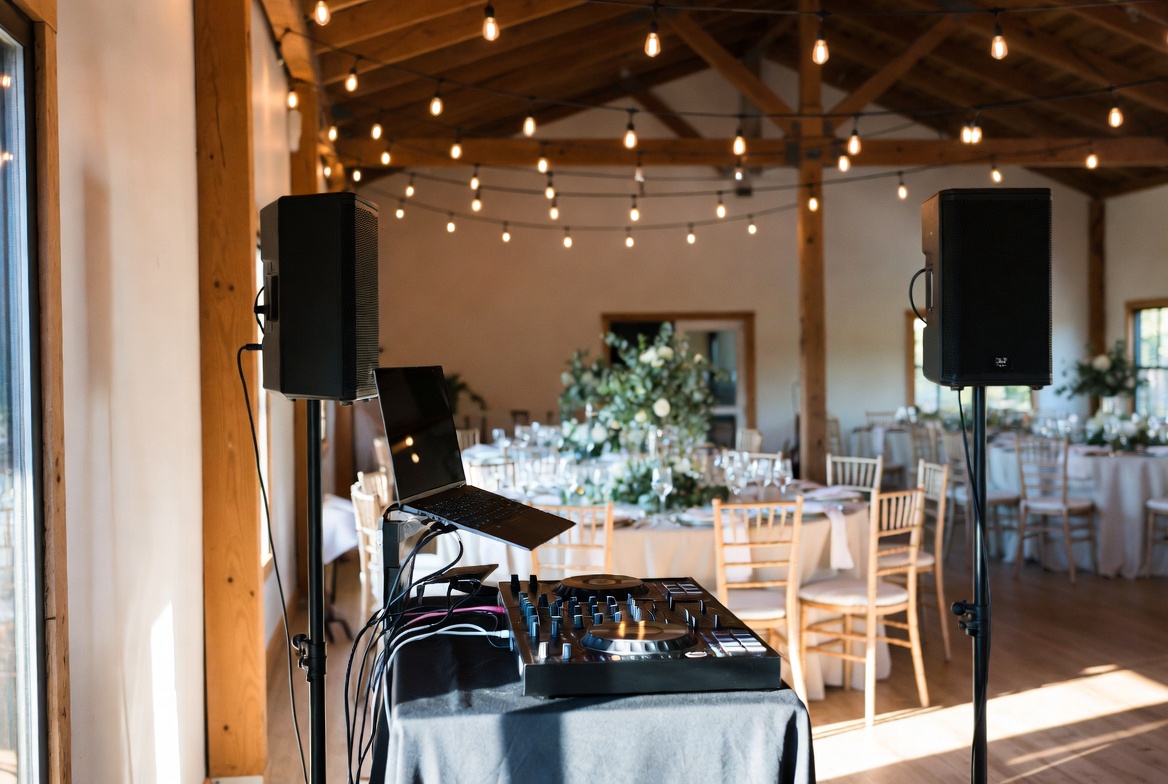
A DJ rig built for 200 guests with subwoofers and a large lighting truss will swallow a 30-person room. Pros bring smaller systems sized for the space. As Phamily DJ put it in March 2025, the massive speakers, subwoofers, and lighting rigs built for big events can feel overwhelming at a gathering of 50 guests or fewer.
MC Tone Changes
A great MC at a small wedding is not loud or cringey. As DJs of Charleston wrote in March 2026, the right MC is calm, clear, and supportive of the vibe you want. Big-room hype doesn't translate to a dinner of 30 friends and family.
Package Shape Can Flex
Ceremony plus cocktail hour only is a real option for couples who don't want a long dance party. Some couples just want professional audio through dinner, then a short dance set, then out.
Playlist Span Gets Wider
With 130 guests, you can sneak a song grandma loves into a 100-song block. With 30 guests, every song reaches everyone. A pro builds sets that work across all ages at the same time, not in shifts.
Question 6: What’s a Fair Way to Budget for a Small Wedding DJ?
We're not going to quote you a fixed number, because DJ pricing depends on hours of coverage, ceremony audio needs, photo booth add-ons, travel, and venue logistics. What we can give you is a sourced framework.
Wedding entertainment has historically run about 4 to 6 percent of total wedding budgets, based on long-standing Modern Bride survey data. According to Premier Bride Wisconsin's November 2025 figures, a typical wedding in our area runs $20,000 to $45,000. The Zola 2026 Wedding Cost Index puts a 150-guest Milwaukee wedding around $42,571, versus $84,649 in San Francisco.
Here's the part most couples miss: per-guest costs are higher for small weddings, not lower. Bespoke Bride summed it up in May 2026: with a 30-person micro wedding, your photographer, DJ, officiant, and other fixed costs are spread across fewer heads. The DJ doesn't pack lighter gear, fewer microphones, or less expertise just because you invited fewer people.
For an accurate number, request a custom quote with your venue, guest count, and start and end times.
Why Couples Cut Entertainment First (And Why They Regret It)
Entertainment Unlimited has long cited Modern Bride survey data showing that 81 percent of guests say the thing they remember most from a reception is the entertainment, and 72 percent of brides wish they had spent more time choosing it.
That's not a marketing line. That's couples in hindsight saying the part of the budget they cut was the part they wish they hadn't.
Professional wedding coordinator Elisabeth Kramer (updated December 2025) framed it this way: DJs serve as cat herders. People planning weddings, particularly for the first time, rarely appreciate how much direction their guests need. As Kramer notes, the cat herder doesn't have to be a DJ, but if you don't hire one, you need to find a cat herder somewhere.
The Milwaukee Noise Ordinance Most Couples Don’t Hear About Until It’s Too Late
If your wedding is happening within Milwaukee city limits, this matters. According to the City of Milwaukee Code of Ordinances, Chapter 80 (current as of the 7/31/2025 supplement), amplified sound that is audible more than 50 feet from the source can trigger a nuisance citation. Quiet hours run 9:00 PM to 7:00 AM.
Outdoor amplified events may require a temporary variance permit. Backyard ceremonies and park-adjacent receptions are the ones that get caught most often.
Two practical tips:
- Contact the City of Milwaukee Department of Neighborhood Services (414-286-2268) at least two weeks before your event if you're hosting outdoors with amplified sound.
- A DJ familiar with the area sets speaker placement and volume to stay compliant. This isn't something a Bluetooth speaker on a picnic table handles well.
Our team at Milwaukee Underground Productions helps couples sort the permitting question early when their venue is within city limits, not on the day of.
DJ vs. Spotify Playlist: An Honest Side-by-Side for Small Weddings
| Factor | Spotify Playlist + Speaker | Professional Small Wedding DJ |
| Ceremony microphone | Not included | Lavalier, handheld, and powered speaker |
| Toast amplification | DIY or shouting | Wireless handheld passed between speakers |
| Reading the room | None (algorithm or shuffle) | Live adjustments every 2 to 3 songs |
| Songs needed | 45 to 60 minimum, pre-screened by you | Built and curated for your guest list |
| Lyric and content screening | Manual | Pre-screened by DJ |
| Timeline coordination | Couple or planner | DJ runs cues with photographer and venue |
| MC announcements | None or designated family member | Professional, calm, vibe-appropriate |
| Equipment for the space | Bluetooth or single speaker | Sized for guest count and room |
| Noise ordinance awareness | Couple's responsibility | DJ sets levels for compliance |
Where a Photo Booth Fits Into a Small Wedding
A photo booth feels like it belongs at a 200-guest wedding. It doesn't. At 30 guests, the math actually works in your favor.
According to Yellow Mirror Photo Booth (May 2025), physical photo strips are still one of the most loved keepsakes from weddings and parties. At a small wedding, the booth doubles as your guestbook and your favors, killing two budget lines at once. Per-guest engagement also goes up because there's no line, so people end up doing three or four sessions across the night, not one rushed strip.
Space-wise, a standard booth needs about 8 by 8 feet, and a 360-degree video booth needs about 12 by 12 feet, per Feature Booth (August 2025). For tight venues, the standard booth fits where a 360 won't.
If you want a Wedding DJ in Milwaukee plus a photo booth bundled into one package, we can build that through our client portal so you're not coordinating two vendors.
The 6-Question DJ Fit Check at a Glance
Before you book or skip a DJ, run through these:
- Ceremony audio: Is your space outdoor, breezy, or larger than 20 guests? If yes, you need amplification.
- Toast mic plan: Will speeches happen in a different room than the ceremony? You need a wireless handheld and a person managing it.
- Room reading: Do you want someone watching the dance floor, or are you fine with a static playlist?
- Playlist depth: Have you actually built 45 to 60 screened songs across cocktail hour, dinner, and dancing?
- Mechanical fit: Is your DJ scaling gear and MC tone to your guest count?
- Budget framing: Are you comparing apples to apples on quotes (hours, ceremony audio, MC, photo booth add-ons)?
If you answered "no" or "I'm not sure" to two or more of these, hiring a pro will likely save the day more than it costs.
FAQs About Hiring a DJ for a Small Wedding
Do I need a microphone for a 30-person wedding ceremony? If the ceremony is outdoors or has any background noise, yes. If it's indoors, quiet, and the officiant projects well, you might get away without one. We still suggest at least a lavalier for the officiant so the back row hears your vows clearly.
Is a DJ worth it for a 30 person wedding? For most couples, yes. The role shifts from filling a dance floor to handling ceremony audio, toast microphones, MC duties, and timeline cues. Those tasks still need to happen at 30 guests.
Do I need a sound system for a 25 person wedding? Probably yes for the ceremony, especially outdoors. For dinner, a small speaker can sometimes cover background music, but toasts will struggle without a handheld mic.
How long should a wedding playlist be for 30 guests? Plan on 45 to 60 songs minimum if you're covering cocktail hour, dinner, and dancing. That's roughly 15 songs per hour of dance time, with songs averaging 3 to 4 minutes.
Who makes announcements at a small wedding without a DJ? Usually nobody, which is the problem. If you skip a DJ, designate a confident family member or your planner as the cat herder to call guests to dinner, introduce toasts, and cue the cake cutting.
Is a photo booth worth it for a small wedding? For 30 to 50 guests, yes, because it doubles as the guestbook and favor. Guests do more sessions because there's no queue, and you walk away with physical prints from every guest.
Do small weddings in Milwaukee need permits for outdoor amplified music? Sometimes. The city's noise ordinance flags amplified sound audible more than 50 feet from the source, and outdoor amplified events may require a temporary permit. Contact the City of Milwaukee Department of Neighborhood Services at least two weeks ahead if you're hosting outdoors.
What if my wedding is at a Lake Country or open-sided venue? Open-sided venues kill natural voice projection. Even at 30 guests, plan on amplification for the ceremony and toasts.
How early should I book a small wedding DJ in Southeastern Wisconsin? Most preferred DJs at popular venues book 9 to 12 months out for peak Saturdays (May through October). Small weekday weddings can sometimes book closer in, but ceremony audio gear gets reserved fast in peak season.
Ready to Talk Through Your Setup?
If you've worked through these six questions and you're still on the fence, the fastest way to get clarity is a short conversation about your venue, guest count, and timeline. The team at Milwaukee Underground Productions has put together small wedding setups across Southeastern Wisconsin, from intimate vineyard ceremonies to 40-guest backyard receptions, and we'll tell you straight whether you need a full DJ package or just ceremony audio.
Through our client portal, you can build a custom quote, sign your contract, and book in 15 minutes or less, with optional add-ons like a photo booth or room lighting. Or just reach out and ask us what makes sense for your size and venue. We'd rather give you an honest answer than upsell you on something you don't need.